Market Updates · 5 min read
Walton County Is Growing. Does That Automatically Make Your Home Worth More?
Population growth, housing competition, and the development questions worth asking before your next move.
 By Simon Mandell
October 22, 2026
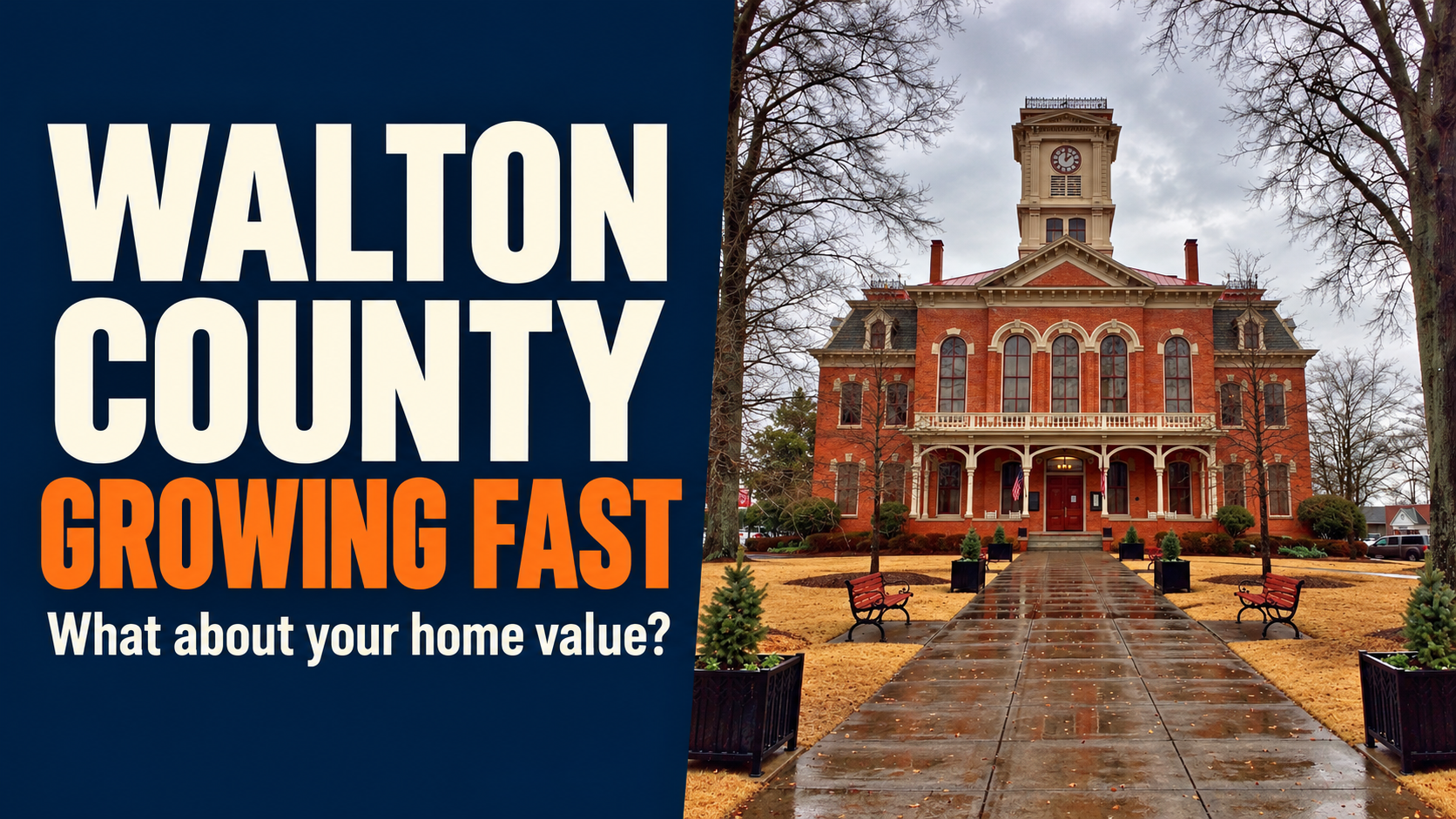
“With everything being built, shouldn’t my house be worth more?” I can see why a Walton County homeowner would ask. Growth can bring customers, jobs, and people who need housing.
It can also bring builders offering new homes to the same buyers you’re hoping to attract. So I’d like to look at where the growth is happening and what buyers can actually choose. That’s the conversation that helps us price your home, rather than simply putting a bigger number beside it.
U.S. Census Bureau estimates published through the Federal Reserve Bank of St. Louis show Walton County’s population increasing from 99,890 in July 2021 to 112,696 in July 2025. That is approximately 12.8% growth in four years. The same series estimates 110,278 residents in 2024, meaning the county added approximately 2,418 residents in one year, or about 2.2%. These are population estimates, not home-sale statistics. Source: Census population estimates through FRED.
| Population snapshot | Estimated residents |
|---|---|
| July 2021 | 99,890 |
| July 2024 | 110,278 |
| July 2025 | 112,696 |
That is a meaningful change. But a growing population does not tell us how many people are shopping in your price range or how much they will pay for your particular home.
In April 2026, Walton County announced an update to its comprehensive plan—a guide for the next 20 years of growth and development. The county identifies land use, transportation, infrastructure, economic development, and broadband among the subjects being considered. Its announcement also explains that the participating cities are coordinating their updates with the county, with Monroe undertaking its process separately. Source: Walton County plan update.
Why should a homeowner care? Because a home’s surroundings are part of its appeal. A buyer may appreciate convenient access to employment or shopping. Another may prioritize open space and a quieter setting. The same development can be a benefit to one buyer and a drawback to another.
When I evaluate a home, I want to understand those tradeoffs.
Here’s the part that gets overlooked: growth can attract builders as well as buyers. If new homes become available near yours, those homes may compete for the same buyer. We need to compare the complete offering:
- The actual purchase price after options and lot premiums.
- Available financing incentives.
- Condition and anticipated maintenance.
- Lot size, privacy, and landscaping.
- HOA costs and restrictions.
- Location and everyday access.
Your established home might have the trees, yard, or location a buyer prefers. The builder may have a warranty or financing offer that gets their attention. I want us to understand that comparison before choosing the advertising price. Your advertising price needs to make sense beside those alternatives. We do not want your home’s price to make the competition look like the obvious choice.
A wooded parcel behind a home can feel like permanent privacy. That appearance alone does not tell us what might happen there. My starting point would be to identify the parcel and the government responsible for its planning decisions. Then we can review available zoning information, development applications, and approvals.
Walton County’s Planning and Development department provides online access to commercial and residential permits and planning and zoning permits. That is a useful starting point for checking a specific location. Source: Walton County Planning and Development. The question should be specific: “What has been submitted or approved for this parcel?”
That gets us closer to an answer than “I heard something is coming.”
For sellers, I want to look at recent comparable sales, current competing listings, concessions, and how long similar homes take to attract an offer. For buyers, I want to compare the home’s price with its condition, location, ownership costs, and the surrounding development picture. County growth gives us context. Your property still needs its own analysis.
Having worked with more than 350 families buying or selling homes, I’ve learned that people want to understand how the bigger picture affects their next move. If you own a home in Walton County, send me your address and ask, “What is changing around me?” We can look at your competition, relevant development information, and what today’s buyers would be comparing your home against.
Data checked October 22, 2026. Population estimates may be revised.
Thumbnail: based on County Courthouse, Monroe, Walton County, Georgia by Farrargirl, brightening by Magnolia677, via Wikimedia Commons. AI-assisted crop, layout, and typography added. Thumbnail adaptation licensed under CC BY-SA 4.0.
Every property and situation is different. These articles offer general considerations, not a property-specific valuation or a guarantee of results.
Explore more stories ↗Selling in Loganville? See the homes I co-listed and how I’d price yours.
Have a home or a question in mind?
Tell me where you are looking or selling, your timeline, and what you need help deciding.
Call Simon: 678-227-8749Text Simon: 678-227-8749 ↗
