Selling · 5 min read
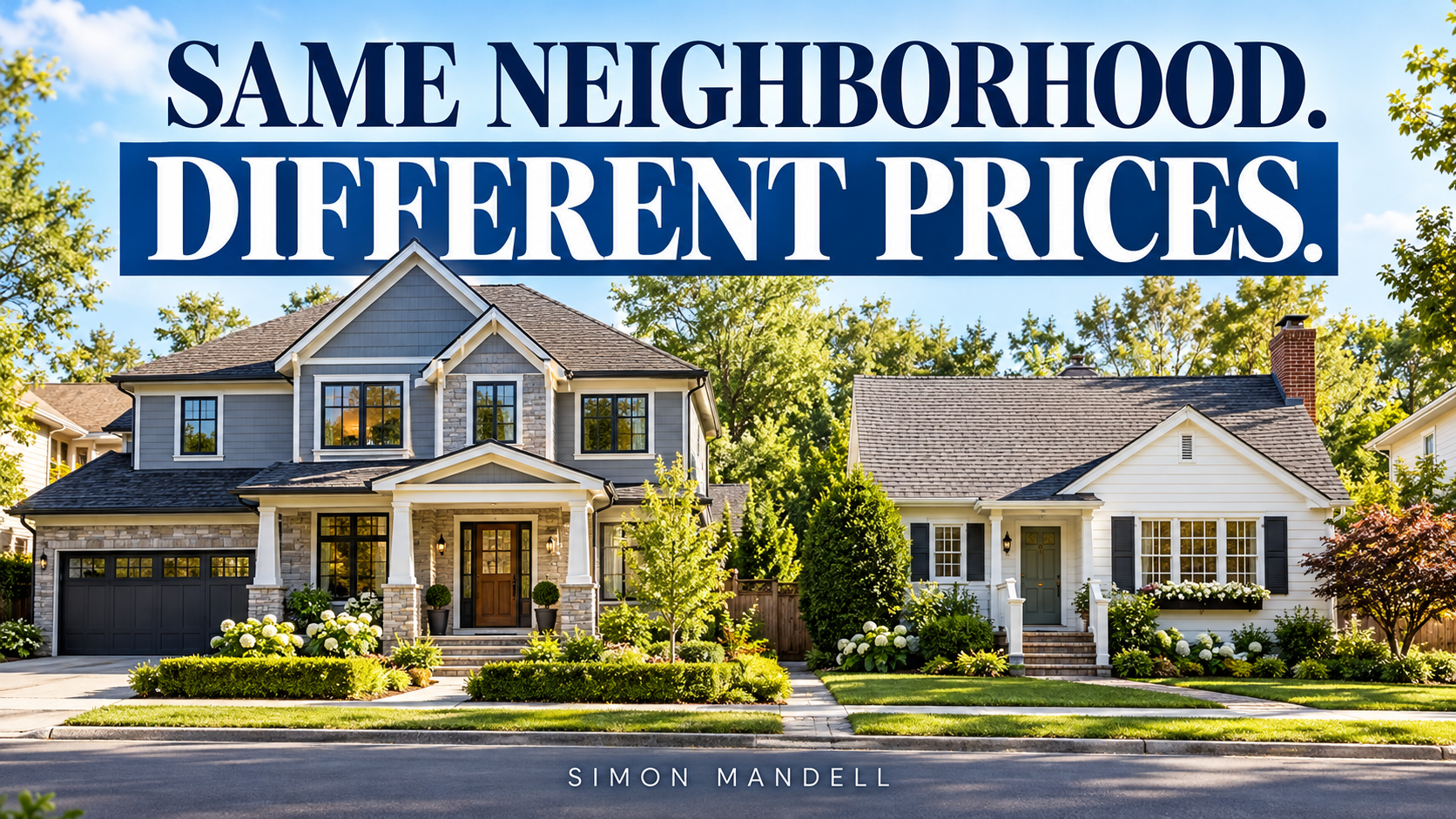
Two Homes, Same Neighborhood. Why Did One Sell for More?
Compare the space, condition, lot, timing, and terms behind the sales price.
 By Simon Mandell
October 17, 2026
Let’s look at your home
Send me your address, recent improvements, and ideal moving timeframe. We’ll start with comparable sales, today’s competition, and what you want to walk away with.
Request my home analysis ↗Text Simon ↗Two listings say 3,000 finished square feet. They’re in the same neighborhood, and they both have four bedrooms. One sells for quite a bit more.
Before we decide one seller did better, let’s open the listings and look past the totals.
One house might have all 3,000 square feet above ground. The other might have 2,000 above ground and 1,000 in the basement. Both offer useful space, but they aren’t the same comparison. Fannie Mae’s measurement guidance distinguishes above-grade and below-grade areas.
The basement may be a great feature. I want to understand its finish, access, ceiling height, and how someone would use it. I just don’t want to treat the two totals as interchangeable.
Now look at “updated.” One listing may mean fresh paint and flooring. The other may include a remodeled kitchen, newer roof, updated bathrooms, and replaced systems. If we call both updated without looking further, we miss a lot.
The lots can differ even on the same street. A level yard, usable driveway, privacy, drainage, and road exposure can change the buyer’s experience. Lot size alone doesn’t explain how much of it you can use.
And then we need the terms.
Suppose one home sells for $450,000 with a $10,000 contribution toward the buyer’s closing costs. Another sells for $442,000 without that contribution. Before all the other expenses and payoffs, that leaves $440,000 from the first and $442,000 from the second.
That’s an illustration of proceeds, not an automatic appraisal adjustment. But it shows why the higher recorded price isn’t always the stronger financial result.
Timing matters, too. A sale that closed months ago may have been negotiated with different competition. The homes available now tell us what buyers can choose today. Pending listings can add context, but we may not know their final price and terms until they close.
When I put a comparison together, I want to explain those differences. I’m not going to add the same amount for every deck or subtract a standard amount for every sloped yard without a reason. The adjustment needs support.
If you’re looking at two sales and wondering why the prices are so different, send me the addresses. We’ll compare the space, condition, setting, terms, and timing. That gets us much closer to understanding your own home than averaging two numbers on a map.
Every property and situation is different. These articles offer general considerations, not a property-specific valuation or a guarantee of results.
Explore more stories ↗Your local selling plan
Have a home or a question in mind?
Tell me where you are looking or selling, your timeline, and what you need help deciding.
Call Simon: 678-227-8749Text Simon: 678-227-8749 ↗